
The Predictive Pivot: How AI and Information Are Redefining Auto Logistics in 2026

AI is now not a luxurious however the baseline for profitability in 2026. Auto haulers that undertake these instruments now will rapidly outpace these utilizing guide workflows and taking a wait-and-see method.
by Vlad Kadurin, Ship.Automobiles
Could 1, 2026
The transportation and logistics (T&L) trade strikes a obtrusive contradiction: the businesses liable for chartering billions of {dollars} in world items have remained digitally out of date for many years.
A 2025 research discovered that 32% of T&L corporations nonetheless depend on paper documentation, and fewer than half have transitioned to predominantly digital codecs.
Once you zero in on the automobile transport and logistics market particularly, the necessity for innovation stays pressing. Traditionally, this market has been a reactive atmosphere — dispatching has at all times been a sport of cellphone calls, guide load boards, and paper trails.
Planning solely begins after the cellphone rings, after which it’s one response after one other: sourcing carriers, dispatching hundreds, issuing gate passes, responding to delays, and so on. In smaller retailers, this can be a one-person job. In bigger corporations, it’s a complete crew attempting to trace downloads and sustain with the work.
Value Headwinds Shake Handbook Method
This guide method is just inefficient. In immediately’s atmosphere, operational prices are rising for a wide range of causes, together with insurance coverage premiums and gasoline costs. Non-fuel operational prices hit file highs lately, in line with the American Transportation Analysis Institute (ATRI).
Insurance coverage premiums have continued a decade-long upward pattern. Whereas beforehand declining from 2023 to 2024, gasoline and upkeep prices have lately seen volatility.
Concurrently, the typical cargo has modified. In 2021, the typical distance of autos moved by sellers doubled from the earlier 12 months’s 225 miles to 500 miles. But, the worldwide pandemic a 12 months earlier launched financial headwinds that in a single day shrunk the variety of carriers, driving demand far above out there provide.
The trade is going through an ideal storm of rising operational prices and hyper-competition. As a result of margins are already razor-thin, seemingly small actions like deadhead miles, inefficient operations, or missed hundreds will be the distinction between revenue and insolvency.
However the availability of synthetic intelligence (AI) has ushered in a brand new period of innovation to an trade that has clung to largely guide processes even by means of the digital wave.
Whereas the final couple of years have been about hypothetical use circumstances and corporations inquisitive about AI’s capabilities, 2026 marks a definitive second when AI has shifted from experimental hype to a core operational engine for the trade. Validation, testing, and beta applications are full, and immediately, AI is remodeling the automobile transport provide chain.

In automotive logistics, agentic AI can steer probably the most time-consuming administration process: dispatching.
Breaking Down the Tech: AI vs. Predictive Analytics
Whereas some corporations are simply scratching the floor of AI’s skills, the automobile logistics trade is surging forward with prospects of how AI can overhaul the time-intensive labor concerned within the day by day work:
Agentic Determination Making
One such use case is agentic AI. In line with McKinsey analysis, 62% of organizations are experimenting with AI brokers, however the provide chain and stock administration sectors have been the next-to-last enterprise features to say that they had reached the scaling part of their corporations.
In automotive logistics, agentic AI can steer probably the most time-consuming administration process: dispatching.
Brokers can act autonomously to counsel hundreds and negotiate charges, sometimes utilizing a mix of a suggestion engine or load board and an agentic voice. Collectively, they will do extra than simply listing freight. They’ll analyze historic exercise to establish probably the most correct match after which contact the provider to supply hundreds.
In some circumstances, these brokers negotiate pricing inside predefined limits set by the logistics firm. On this case, AI does way more than interpret knowledge. It might make selections, act on that knowledge, and carry out a few of the high-volume and low-judgment duties that eat up most of a dispatcher’s day.
Predictive Analytics
The logistics trade has tried to make use of predictive analytics prior to now, utilizing historic knowledge to roughly forecast anticipated swings in demand and different metrics. However AI predictive analytics can establish micro and macro tendencies to a level of accuracy and precision that was merely inconceivable earlier than.
By combining historic knowledge with real-time inputs resembling climate, site visitors, and port congestion, predictive analytics can establish and handle disruptions earlier than they manifest.
If a provider with a small fleet accepts a number of autos throughout far-apart areas whereas a storm is growing on a key route, the system can establish the danger early and set off motion earlier than the disruption hits, resembling reassigning the load, warning the shipper, or adjusting expectations upfront.
This not solely solves the problem at hand, however, as with every part within the provide chain, one disruption normally causes a domino impact, affecting a number of hundreds over days or even weeks.
Information Integrity
The standard of the info feeding these programs finally determines whether or not a system is subpar or glorious. Some platforms rely solely on scraped knowledge or third party-inferred knowledge, which will be unreliable or simply reduce off.
AI allows logistics corporations to make use of their very own knowledge to tell future hundreds, however they have to first seize that knowledge. Sadly, many suppliers solely doc binary outcomes somewhat than event-level structure. When evaluating carriers, it’s way more correct to categorize them based mostly on micro-decisions throughout a load than to easily consider whether or not a load was delivered.
One takes within the full context of the load’s journey, whereas one solely assumes success or failure based mostly on the result.
In a legacy system with binary outcomes, a load could also be documented as “delivered” or “profitable” if it arrived inside the promised 4-hour window. Nonetheless, that knowledge doesn’t delve into the small print of the driving force’s selections that decided the timeline, resembling whether or not the load adopted the really helpful route or one the driving force deliberate.
If solely the result is documented, the logistics supplier has no perception into the dangers or inefficiencies related to a selected provider or route. Nonetheless, if event-level knowledge is captured, resembling route choice, deviations from the route, dwell time evaluation, and extra, the system learns which carriers are extra dependable and which make higher essential selections that affect buyer satisfaction and cargo security.
Counting on outcomes is the equal of taking a cross/fail course. It confirms completion however ignores competence. Occasion-level structure, however, offers a sliding scale of 4.0. This enables automobile transport corporations to cease guessing why a load was unsuccessful and redefine what is taken into account success to start with.
Suggestions Loops
Finally, AI allows automobile logistics corporations to show static knowledge into movement. Whereas event-level structure allows a dealer to raised consider a provider, it additionally allows AI to guage and enhance predictions.
If knowledge is just marked delivered however nobody closes the loop to attach when predicted outcomes match — or extra importantly, don’t match — the precise final result, the info stays the identical, persevering with to offer inaccurate predictions based mostly on the identical prior knowledge.
However when AI incorporates suggestions loops and predicted outcomes are in contrast with precise supply occasions, previous shipments inform future shipments, and the system learns and refines its accuracy. This implies the predictive fashions stay dynamic and predictions get nearer to actual outcomes with every new knowledge enter.
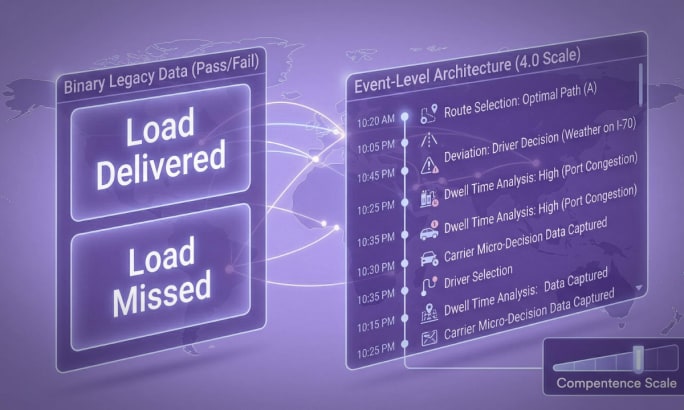
If event-level knowledge is captured, resembling route choice, deviations from the route, dwell time evaluation, and extra, the system learns which carriers are extra dependable and which make higher essential selections that affect buyer satisfaction and cargo security.
Impression on Core Metrics: Utilization and Forecasting
AI’s most blatant and trackable impression is on the transport trade’s core metric: deadhead miles.
Almost one-thirdof the miles pushed annually are spent on the street with an empty or insufficiently full trailer whereas drivers are navigating between hundreds. These miles are essential to get to the subsequent job, but are unpaid and thus misplaced income. AI can intelligently sequence pickups and drop-offs to make sure trailers keep at most capability. When carriers can visualize and safe probably the most environment friendly routes by means of AI-driven routing instruments, they will streamline fleet utilization.
Then there’s strategic forecasting. The automobile transport trade sees provide and demand rise and fall seasonally: snowbird migration drives heavy site visitors in sure lanes, the financial system tightens, resulting in a rise in repossession-driven demand, and end-of-lease cycles spike auction-driven exercise.
AI-empowered platforms can sense these shifts, alerting logistics corporations to allow them to higher plan capability, figuring out what number of drivers they’ll want in just a few weeks somewhat than reacting as soon as they’re wanted.
The Remarketing Revolution: Information-Pushed Resale
For the automobile remarketing trade, days to market are probably the most essential metric. Daily a automobile sits in reconditioning or transit, its worth drops, and the seller has potential money stream wrapped up in it.
AI can automate inspections and logistics workflows instantly when a automobile is flagged for remarketing, lowering the turnaround time.
AI may also decide the candy spot for automobile pricing based mostly on real-time market saturation and regional demand. That reduces reliance on final quarter’s gross sales metrics, which can not adequately mirror market ebbs and flows or regional tendencies, leading to misplaced income from underpriced stock or elevated days on lot from overpriced stock.
For industrial clients, AI helps fleet managers perceive the whole value of possession and optimize it, making certain a fleet automobile is bought earlier than upkeep prices outweigh its residual worth. AI may also assist keep the fleet by means of predictive upkeep screens.
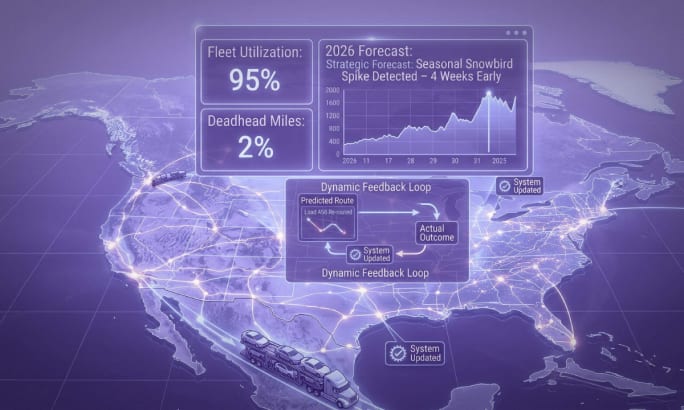
When AI incorporates suggestions loops and predicted outcomes are in contrast with precise supply occasions, previous shipments inform future shipments, and the system learns and refines its accuracy.
Adoption Patterns: Who’s Leveraging or Going through Obstacles
The early adopters of AI within the automotive logistics trade are typically bigger fleets already utilizing AI-integrated platforms as command facilities to handle 1000’s of belongings and complicated multi-state strikes.
These are typically organizations with the manpower to tackle a brand new know-how integration with out lacking a beat. Concurrently, SaaS platforms give smaller fleets the identical routing energy as a nationwide provider, probably enabling entry to scale and revenue that was maybe beforehand out of attain.
Nonetheless, regardless of its advantages, most fleets stay cautious, largely because of the problem of transferring from a legacy system to a contemporary, AI-integrated system, in addition to the pure hesitation to belief an autonomous agent over human instinct.
There are alternatives for modular integrations that enable corporations to improve in levels or by particular elements. Many resolution suppliers provide low-risk trial applications to display ROI earlier than committing to a full digital transformation, in addition to API-compatible platforms that instantly hook up with legacy software program.
These instruments can assist and increase present operations somewhat than utterly take over. This managed evolution method delivers incremental enhancements, permitting groups to construct belief in know-how whereas scaling at their very own tempo.
The Roadmap to Information-Pushed Success
AI is now not a luxurious however the baseline for profitability in 2026. Firms that undertake these instruments now will rapidly outpace these taking a wait-and-see method, remaining caught in guide workflows.
The aggressive hole will solely widen as these utilizing AI automate workflows and discover extra efficiencies, whereas those that wait try to catch up.
Previously, a wait-and-see method meant you have been behind by just a few weeks or months, however with AI, programs study and enhance each day, and the tempo of innovation, and thus the tempo of competitors, will solely velocity up, changing into additional and additional out of attain.


