The Waffle Home Impact: How They Impacted How Storms are Measured Whereas Protecting Scorching Meals Prepared

Why one restaurant chain turned a benchmark for catastrophe response and what fleets can study readiness, operations, and restoration.
If there may be one factor we will all agree on, it’s {that a} sizzling meal throughout instances of stress will be therapeutic. That premise guides the philosophy behind the emergency preparedness mannequin that has made the Waffle Home the unofficial barometer of emergency response readiness.
Dubbed the “Waffle Home Index” by then Federal Emergency Administration Company (FEMA) director W. Craig Fugate, it’s a fast approach to gauge the extent of injury in an space after a pure catastrophe.
“Provide chain design is historically optimized for value and effectivity below steady, regular situations. Nevertheless, the Waffle Home mannequin proves that true resilience have to be engineered into the operational system from the bottom up, reasonably than handled as an afterthought,” stated Panos Kouvelis, distinguished professor and director of the Boeing Heart for Provide Chain Innovation at Washington College. “By standardizing their restaurant layouts, gear, and menus, they’ve created a extremely modular provide chain. When a catastrophe strikes, this standardization permits them to seamlessly plug in emergency assets like transportable mills, cell command facilities, and standardized aid provides.”
When excessive climate strikes, Waffle Home’s “At all times Open” philosophy serves not solely to feed its neighborhood but additionally as a beacon of security.
The Waffle Home Index Colour System
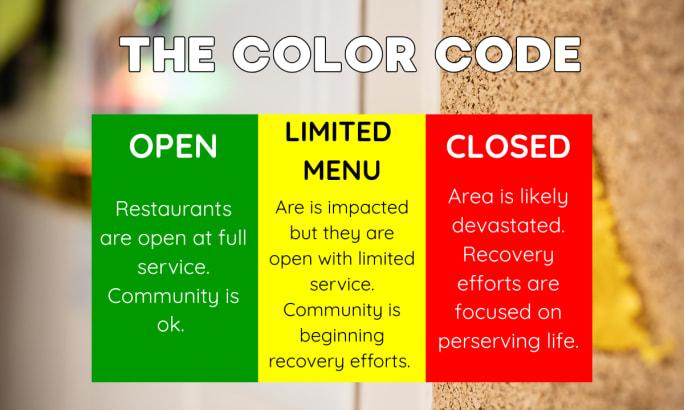
The colour-coded system is easy and straightforward to know.
Waffle Home catastrophe restoration has such a powerful status for fulfillment that the Federal Emergency Administration Company (FEMA) informally makes use of it to evaluate the severity of a pure catastrophe occasion.
Fugate as soon as stated, “When you get there and the Waffle Home is closed? That’s actually unhealthy.”
The Waffle Home Index makes use of a three-color code system: inexperienced, yellow, and crimson.
Inexperienced, like regular, means go! That is when the restaurant is open and absolutely operational, and the neighborhood is unaffected.
If they’re serving a restricted menu attributable to energy outages, it falls into the yellow classification. Yellow suggests there could also be disruptions within the space.
Purple signifies that Waffle Home is totally closed. This classification would counsel extreme disruptions to the neighborhood with vital challenges to residents after a catastrophe.
The simple and practically common use of colours like inexperienced, yellow, and crimson makes this method efficient and sensible.
The Waffle Home Plan
The Waffle Home’s capacity to “get the lights on” so rapidly after a catastrophe is instantly tied to its proactive method and superior planning.
-
Storm Heart: The Waffle Home Storm Heart is positioned in Norcross, Georgia, and it serves as its personal “State of affairs Room” throughout hurricanes and different pure disasters. From there, they observe energy ranges, handle provide chains, and inform FEMA’s injury evaluation.
-
Cellular Command Heart: Additionally they have a cell command middle, named EM-50, that they deploy to disaster-stricken areas as wanted. These command facilities are customized RVs outfitted with satellite tv for pc telephones and web hyperlinks. It doubles as a cell area workplace and works alongside the Waffle Home meals truck, which can also be deployed throughout catastrophe aid efforts.
-
Bounce Groups: Bounce groups include managers who’re educated for swift catastrophe response. As quickly as a hurricane or different catastrophe is predicted, they mobilize and start coordinating what could also be wanted within the area.
-
Menu Variations: Waffle Home has a pre-printed “no energy” menu with restricted objects that require minimal cooking or will be ready utilizing different heating strategies.
-
Emotional Assist: Whereas the Waffle Home Index and their emergency preparedness are tangible, their presence in disaster-stricken areas additionally serves the neighborhood spirit. Their capacity to stay open and serve their neighborhood helps heal communities coping with the stress and strife of pure disasters.
Why It Works
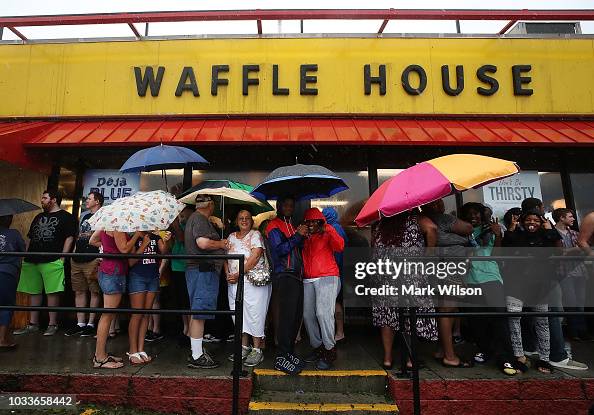
Folks ready to eat at a Waffle Home in North Carolina sooner or later after Hurricane Florence made landfall.
The important thing element to the Waffle Home catastrophe aid efforts is easy: planning.
Waffle Home’s capacity to function in a “degraded” state is the cornerstone of its continuity. Whole shutdowns result in large income loss, asset stranding, and delayed restoration instances, in keeping with Prof. Kouvelis.
The flexibility to function in a degraded state implies that organizations can proceed to carry out their capabilities even when at lowered capability.
Prof. Kouvelis says “fleets can construct this actual sort of flexibility by establishing predefined, drained service protocols.”
-
First, they need to outline service tiers prematurely: what have to be delivered it doesn’t matter what, what will be delayed, and what will be suspended.
-
Throughout a disaster, a fleet ought to possess the operational agility to instantly shift to transporting solely high-priority freight, akin to emergency provides or crucial medical gear.
-
They need to quickly droop normal or low-priority deliveries to preserve bandwidth and gasoline.
-
They need to standardize contingency working modes, akin to reduced-route dispatching, alternate fueling, and pre-authorized driver reassignment.
-
Lastly, they need to prepare for working below impairment, not only for working below supreme situations.
Waffle Home additionally has an in-house, written, and recurrently up to date crisis-management plan known as the Waffle Home Playbook. In a current LinkedIn publish, Fugate famous:
It’s principally the OODA Loop — Observe, Orient, Resolve, Act — minus the Pentagon PowerPoint. Present up → Observe (see the truth for your self — and bear in mind, you’re not scrambling eggs with out your group). Assess → Orient/Resolve (work out what’s damaged, what’s wanted, what works — no marketing consultant required). Act → Act (fireplace up the grill, feed folks, preserve transferring).
When a catastrophe strikes, they keep on with the plan, they preserve communities knowledgeable, and when it’s achieved, they assess and analyze what occurred, what labored, and what didn’t, after which replace their processes accordingly.
Sensible Steps for Fleet Managers
“Proactive pre-positioning aligns completely with superior threat mitigation methods as a result of it shifts a company from a reactive posture to an anticipatory one. Relatively than reacting after the disruption hits, corporations transfer crucial supplies, gear, or personnel into strategically chosen areas earlier than situations deteriorate.” – Professor Panos Kouvelis, Washington College
We requested Prof. Kouvelis what fleet managers can do now to enhance continuity and restoration pace within the face of accelerating disruptions, and he had the next suggestions:
-
Conduct Rigorous State of affairs Planning: Companies should establish their most important vulnerabilities and map out actual, step-by-step responses for varied catastrophe eventualities. Companies ought to start by figuring out their important capabilities, their crucial suppliers and property, and the few failure factors almost certainly to close them down.
-
Outline a Degraded Working Mannequin: This reduces choice latency, which is usually extra damaging than the disruption itself. Know prematurely which providers proceed first, which prospects are the very best precedence, and which handbook workarounds are acceptable.
-
Spend money on Redundant Techniques: That is particularly crucial for visibility. Fleets should spend money on redundant communication and monitoring techniques, akin to satellite tv for pc capabilities, to take care of asset visibility when main mobile networks fail.
-
Set up “Bounce Groups” and Cross-Coaching: Waffle Home brings in workers from unaffected areas to run their impacted eating places. Fleets ought to set up reserve driver swimming pools and cross-train dispatchers to allow them to step in for native personnel who must attend to their very own households and broken properties throughout a disaster.
-
Rehearse and Measure: Even a easy tabletop train can reveal astonishing weaknesses involved lists, approval processes, gasoline entry, dispatch visibility, and worker accountability. Resilience is a muscle; corporations that by no means check it are normally shocked the place it snaps.
Prepositioning can also be important for profitable disaster administration. Prof. Kouvelis suggests fleets with heavy logistics stage important property simply outdoors the anticipated impression zone earlier than the disruption absolutely happens.
This will embody relocating idle vehicles away from flood zones, securing cell fueling stations, and/or positioning backup communication gear at secondary hubs.
From a list technique perspective, pre-positioning might look a bit completely different. For these fleets, he identifies three key objects: establish a small set of actually crucial objects that drive continuity, place these objects at protected however accessible areas, and monitor the state of affairs so that you could be act earlier than congestion, closures, or infrastructure injury make motion tough.
“The deeper lesson from the Waffle Home instance just isn’t merely that one firm stays open throughout storms. It’s that resilient organizations design their provide chains and operations to stay purposeful below constraint,” added Prof. Kouvelis. “They simplify, when obligatory, preposition intelligently, empower native response, and know find out how to function at lower than 100% with out collapsing to zero. For fleets and small companies going through more and more frequent disruptions, that’s the actual playbook: not perfection below stress, however continuity by way of adaptability.”


