
How Upkeep Prices Evaluate Throughout 27 Fleet Autos

Upkeep has develop into a significant stress level in fleet budgets. The price of automobile upkeep and repairs elevated 41% between 2020 and 2025, in line with federal inflation knowledge, and costs continued rising into 2026. Components value extra, store labor charges have climbed, and technician availability has tightened, notably for diesels.
TechForce Basis estimates that the variety of college students finishing automotive technician applications is 29% wanting annual trade demand, whereas the hole is 52% for diesel technicians.
Fleets can’t management the technician scarcity, however they’ll higher perceive how automobile choice impacts the quantity and sort of upkeep they’re seemingly to purchase. Upkeep is rarely the primary consideration when spec’ing, however taking it under consideration issues as prices climb, notably when multiplied throughout tons of of items.
To look at how these prices fluctuate, Automotive Fleet labored with the lifecycle value specialists at Vincentric to check projected upkeep bills for 27 model-year 2026 configurations. The evaluation covers 5 fleet segments over three years or 60,000 miles and separates manufacturer-scheduled companies from anticipated put on objects resembling tires, brakes, wiper blades, and bulbs, which Vincentric classifies as unscheduled upkeep.
Vincentric treats repairs (surprising companies) as a separate value class. Repairs and guarantee work usually are not included on this knowledge.
The outcomes shouldn’t be interpreted as complete section rankings or buying suggestions. The purpose is to not establish the fashions with the bottom upkeep prices; it’s to point out what fleets might miss when upkeep knowledge shouldn’t be a part of the spec’ing course of.
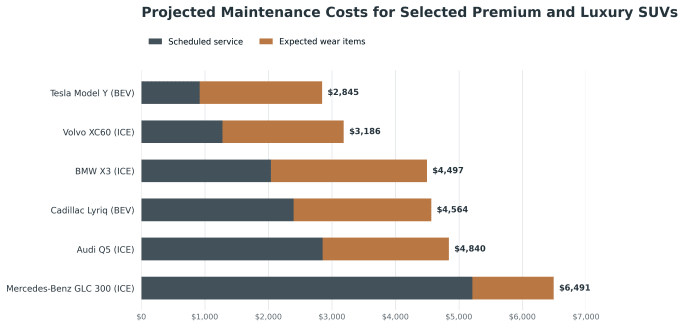
Vincentric’s three-year/60,000-mile projections reveal important maintenance-cost variations on this class, with the Tesla Mannequin Y posting the bottom projected whole and the Mercedes-Benz GLC 300 the very best.
Upkeep Prices Fluctuate Extensively
Even inside these restricted comparability units, the projected upkeep value variations had been substantial. The hole between the lowest- and highest-cost examples ranged from $1,686 among the many chosen half-ton pickups to $3,646 amongst premium and luxurious SUVs.
Among the many chosen cargo vans, the vary was $2,842 per automobile. It reached $2,672 amongst compact SUVs and $3,499 amongst passenger automobiles.
These figures don’t set up which automobile a fleet can purchase. However projected upkeep variations that seem comparatively modest on a per-unit foundation can develop into materials at scale.
The composition of these prices issues as properly. A automobile might have comparatively low manufacturer-scheduled service prices however larger anticipated spending on tires, brakes and different put on objects.
One other might require extra frequent or costlier scheduled service. Wanting beneath the full helps fleets perceive not solely how a lot they might spend, however the place that expense is predicted to originate.
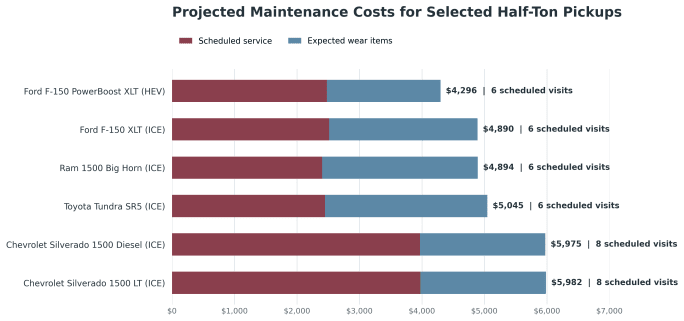
Vincentric’s projected upkeep prices cowl three years/60,000 miles and embrace manufacturer-scheduled service and anticipated put on objects. Scheduled visits are proven as a result of even small variations in service frequency can multiply into tons of or 1000’s of extra store occasions throughout a big pickup fleet.
Hybrids Strengthen Their TCO Case
Hybrids are already sturdy TCO performers as a result of they mix lowered gasoline consumption with comparatively favorable depreciation and resale values. The Vincentric knowledge additionally exhibits that chosen hybrids are aggressive on upkeep.
The Ford F-150 PowerBoost has the bottom projected upkeep value among the many six chosen half-ton pickups at $4,296 over three years/60,000 miles. That’s $594 lower than the standard F-150 configuration within the comparability and almost $1,700 beneath the chosen Chevrolet Silverado gasoline and diesel fashions.
The Toyota RAV4 Hybrid’s $4,510 projection is the second lowest among the many 5 chosen compact SUVs. The Toyota Camry Hybrid’s projected $4,515 whole is beneath these of the chosen Hyundai Sonata and Nissan Altima.
Nonetheless, fleets planning to function automobiles past the three-year/60,000-mile window ought to lengthen the evaluation, as a result of hybrid-specific upkeep necessities might develop into extra important at larger mileages.
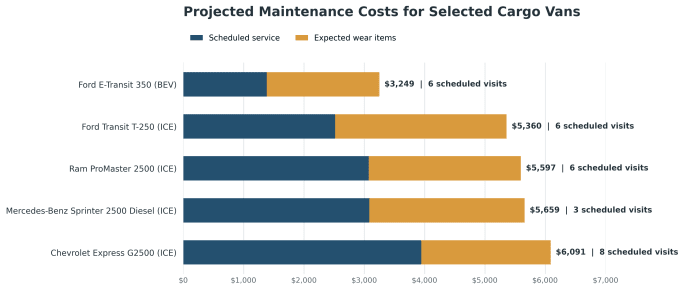
Vincentric’s projected upkeep prices cowl three years/60,000 miles and embrace manufacturer-scheduled service and anticipated put on objects. Scheduled visits are included as a result of service frequency can create downtime and operational prices that aren’t mirrored within the upkeep whole alone.
Powertrain Doesn’t Inform the Entire Story
The chosen battery-electric automobiles typically carry out properly. The Tesla Mannequin 3 and Mannequin Y have the bottom projected upkeep prices of their respective comparability teams, whereas the Ford E-Transit posts the bottom whole among the many chosen cargo vans.
Electrification doesn’t assure the bottom upkeep value. The Cadillac Lyriq’s projected $4,564 whole exceeds the gasoline-powered Volvo XC60’s $3,186 and BMW X3’s $4,497. The $1,719 distinction between the Lyriq and Tesla Mannequin Y additionally demonstrates that two BEVs in the identical class can carry completely different prices.
The compact SUVs reinforce the purpose. The gasoline-powered Volkswagen Tiguan has the bottom projection in that chosen group at $3,728, forward of the RAV4 Hybrid at $4,510 and three different gasoline-powered fashions.
A automobile’s service schedule, anticipated put on prices and manufacturer-provided upkeep program can affect the outcome alongside its powertrain. A number of automobiles within the evaluation embrace factory-paid scheduled upkeep for a portion of the three-year cycle. Fleets ought to perceive what these applications cowl, how lengthy the protection lasts, and whether or not service areas align with their working footprint.
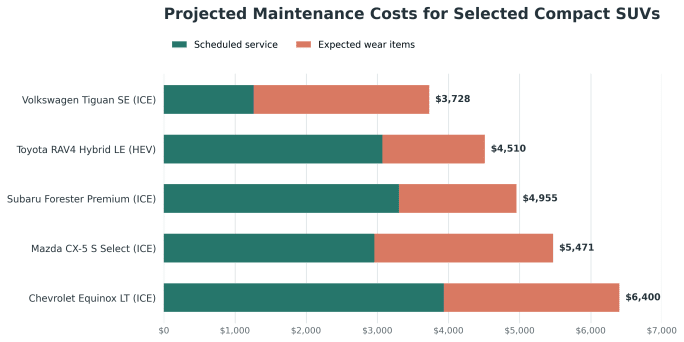
Vincentric’s three-year/60,000-mile projections present how manufacturer-scheduled service and anticipated wear-item prices fluctuate amongst chosen compact SUVs. The gas-powered VW Tiguan has the bottom projected whole on this comparability, adopted by the Toyota RAV4 Hybrid.
Downtime Adjustments the Calculation
For revenue-generating vans and vans, the upkeep bill might not be the most important consequence. What’s extra essential are canceled appointments, delayed tasks, extra time, rental expense, and dissatisfied prospects.
That makes scheduled service frequency one other specification to look at. Vincentric tasks solely three scheduled upkeep visits for the Mercedes-Benz Sprinter over three years/60,000 miles, in contrast with six for the E-Transit, Ford Transit and Ram ProMaster and eight for the Chevrolet Specific.
The Sprinter doesn’t have the bottom projected upkeep value, however its 20,000-mile service interval may present operational worth for fleets that place a premium on holding vans in service.
The chosen pickups provide one other instance. The F-150, F-150 PowerBoost, Ram 1500 and Toyota Tundra every have six projected scheduled visits. The 2 Silverados have eight. Two extra visits might seem inconsequential for one truck, however throughout 500 items, they create 1,000 extra service occasions throughout the alternative cycle.
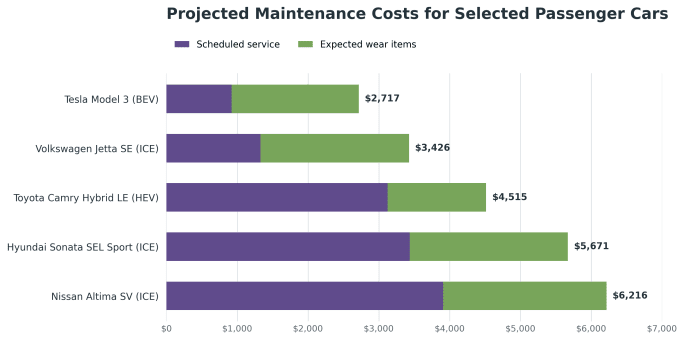
Over three years/60,000 miles, Vincentric tasks the Tesla Mannequin 3 can have the bottom upkeep value amongst these chosen passenger automobiles.
Put Upkeep Into the Spec’ing Dialogue
None of those projections ought to decide automobile choice by itself. The bottom-maintenance automobile might not have the payload, vary, tools, security options or working traits the fleet requires. A barely higher-cost automobile may additionally ship higher uptime, stronger resale worth or higher total TCO.
The evaluation as an alternative demonstrates why upkeep ought to have an outlined place within the spec’ing course of. Fleets ought to search projections that match their supposed alternative cycle, study scheduled service and anticipated put on objects individually, evaluation factory-paid protection and think about the operational impact of service frequency.


