
Engine Longevity 101: Stopping Carbon Buildup in Trendy Diesel Engines : Automotive Addicts

The legend of the “million-mile diesel” is a cornerstone of automotive lore. For many years, the recipe for a heavy-duty truck was easy: an enormous cast-iron block, a mechanical gasoline injection pump, and a turbocharger. These older generations of Cummins, Powerstroke, and Duramax engines had been famously overbuilt, able to outlasting the very chassis they had been bolted to.
The legend of the “million-mile diesel” is a cornerstone of automotive lore. For many years, the recipe for a heavy-duty truck was easy: an enormous cast-iron block, a mechanical gasoline injection pump, and a turbocharger. These older generations of Cummins, Powerstroke, and Duramax engines had been famously overbuilt, able to outlasting the very chassis they had been bolted to.
Nevertheless, for those who discuss to any trendy diesel mechanic in the present day, they’ll let you know that the panorama has drastically modified. Whereas trendy diesel engines produce extra horsepower and torque than ever earlier than straight from the manufacturing unit flooring, they face a silent, choking adversary that their predecessors by no means needed to take care of: extreme carbon buildup.
If you’re a truck fanatic, a fleet supervisor, or somebody who depends on their heavy-duty pickup for towing, understanding how carbon buildup types and tips on how to forestall it’s the single most necessary consider extending the lifetime of your truck. On this complete information, we’re going to dive deep into the anatomy of contemporary diesel engines, the emissions programs that inadvertently trigger inner sludge, and the simplest methods to maintain your engine respiratory clear and working robust for lots of of hundreds of miles.
The Paradox of Trendy Diesel Engines
To grasp the issue, we first have to have a look at the evolution of diesel engineering over the past twenty years. As emissions rules grew to become considerably stricter, automotive producers had been compelled to develop extremely advanced exhaust after-treatment programs. The aim was noble: scale back the quantity of nitrogen oxides (NOx) and particulate matter (soot) expelled from the tailpipe.
To attain this, producers carried out a sequence of programs, most notably the Exhaust Gasoline Recirculation (EGR) valve, the Diesel Particulate Filter (DPF), and Selective Catalytic Discount (SCR) programs requiring Diesel Exhaust Fluid (DEF). Whereas these applied sciences efficiently cleaned up the exhaust exiting the tailpipe, they inadvertently created an enormous downside contained in the engine itself. As a substitute of expelling all of the soot into the environment, trendy diesel engines are compelled to “swallow” a portion of their very own exhaust.
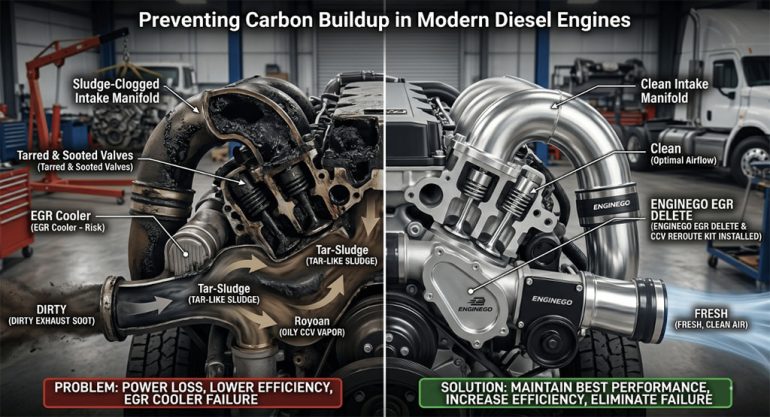
Once you mix scorching, soot-laden exhaust gasoline with oil vapors generated by the engine’s crankcase, you create an ideal storm. The result’s a thick, tar-like sludge that coats the consumption manifold, the valves, and important sensors. Over time, this carbon buildup strangles the engine, robbing it of energy, destroying gasoline economic system, and finally resulting in catastrophic element failure.
The Main Wrongdoer: Exhaust Gasoline Recirculation (EGR)
On the very coronary heart of the carbon buildup epidemic is the Exhaust Gasoline Recirculation (EGR) system. The EGR system operates on a comparatively easy idea: it takes a portion of the new exhaust gases leaving the engine and routes them again into the consumption manifold to be burned a second time. As a result of exhaust gasoline accommodates much less oxygen than contemporary air, introducing it into the combustion chamber lowers the general combustion temperature. Decrease combustion temperatures end result within the manufacturing of fewer NOx emissions.
Whereas this seems to be nice on an emissions check, the mechanical actuality is a nightmare for engine longevity. Diesel exhaust is inherently soiled. It is stuffed with unburned hydrocarbons and abrasive soot particles. Earlier than this scorching exhaust will be reintroduced into the engine, it should go by way of an EGR cooler to decrease its temperature.
The Downward Spiral of the EGR System
As soot passes by way of the EGR cooler and into the EGR valve, it begins to build up. Slowly however absolutely, the passages throughout the cooler turn out to be restricted. As soon as the EGR valve itself turns into caked in dry soot, it could possibly stick open or closed, triggering a cascade of engine codes and throwing the truck into “limp mode.”
Even worse is what occurs when an EGR cooler fails. As a result of the cooler makes use of engine coolant to decrease the temperature of the exhaust gasoline, a carbon-choked and thermally pressured cooler can crack. When this occurs, coolant leaks straight into the exhaust or the consumption. If coolant enters the combustion chamber in massive sufficient portions, it could possibly trigger engine hydro-locking, a catastrophic occasion that bends connecting rods and requires an entire engine rebuild.
For truck homeowners who use their autos strictly for off-road purposes, closed-course competitors, or farm use the place freeway emissions rules don’t apply, probably the most definitive strategy to forestall this particular sort of carbon buildup is by eradicating the system solely. By putting in high-quality EGR delete kits, off-road fans can block off the exhaust circulation to the consumption manifold solely. This ensures that the engine solely breathes contemporary, clear, oxygen-dense air.
Specialised aftermarket suppliers like EngineGo have turn out to be the go-to supply for these heavy-duty block-off plates and bypass programs, permitting competitors truck builders to drastically decrease their combustion temperatures, enhance throttle response, and remove the chance of a blown EGR cooler taking out their engine.
The Silent Killer: Crankcase Air flow (CCV)
Whereas the EGR system introduces dry soot into the consumption, soot alone doesn’t create the sticky, black sludge that ruins engines. Dry soot can simply be blown by way of the combustion chamber. The aspect that turns that soot right into a damaging tar is oil vapor, and that vapor comes from the Crankcase Air flow (CCV) system.
In each inner combustion engine, a small quantity of combustion gasoline “blows by” the piston rings and pressurizes the oil pan and crankcase. This stress have to be vented to forestall the engine from blowing out its principal seals. In older autos, this stress was merely vented out a tube into the environment (usually referred to as a “highway draft tube”). Nevertheless, trendy environmental requirements dictate that these oily crankcase vapors have to be routed again into the engine’s consumption system to be burned off.
The Lethal Mixture: Soot Meets Oil
When the CCV system routes oil-saturated air into the consumption tract, it coats the within of the turbocharger compressor wheel, the intercooler piping, and the consumption manifold with a superb layer of motor oil. If in case you have ever taken aside the intercooler piping on a factory-stock trendy diesel, one can find it slick with engine oil.
By itself, this oil vapor is a nuisance that lowers the effectivity of the intercooler. However when this oily movie meets the dry soot being pumped in by the EGR system, a chemical response happens. The soot and oil mix to kind a thick, baked-on carbon sludge. This sludge clings to the consumption valves, severely limiting airflow. Over tens of hundreds of miles, the diameter of the consumption manifold ports will be diminished by half, forcing the turbocharger to work twice as exhausting simply to push the identical quantity of air into the cylinders.
To fight this, devoted off-road and track-truck builders depend on CCV reroute kits. A correct CCV reroute modifies the manufacturing unit system in order that the oily crankcase vapors are both vented to the environment (by way of a catch can or draft tube) or aggressively filtered earlier than they will attain the turbocharger.
Manufacturers like EngineGo engineer these reroute programs particularly for high-performance Duramax, Cummins, and Powerstroke purposes. By implementing a CCV reroute, homeowners be sure that their intercoolers stay utterly dry and their consumption manifolds stay freed from sludge, permitting the engine to keep up its manufacturing unit airflow dynamics indefinitely.
Past the {Hardware}: Routine Upkeep for Longevity
Whereas {hardware} modifications are the gold normal for devoted competitors autos, they aren’t strictly authorized for street-driven vans. If you’re working a every day driver or a business fleet car that should retain its manufacturing unit emissions tools, you can’t merely delete the EGR or CCV programs. As a substitute, you could depend on aggressive, proactive upkeep to struggle carbon buildup.
1. Frequent Oil Adjustments with Premium Synthetics
The oil in a contemporary diesel engine works considerably more durable than it did twenty years in the past. As a result of the engine is compelled to ingest its personal soot, that soot finally washes previous the piston rings and contaminates the engine oil. This abrasive soot acts like liquid sandpaper contained in the engine, carrying down principal bearings and camshaft lobes.
Don’t belief the producer’s prolonged 10,000-mile oil change intervals. To forestall soot agglomeration within the oil, you have to be altering your diesel engine oil each 5,000 to 7,500 miles, using high-quality full artificial oils that carry the newest API CK-4 score. These trendy oils comprise superior dispersants particularly designed to droop soot particles and hold them from clumping collectively.
2. Excessive-High quality Gas and Gas Components
Diesel gasoline high quality varies wildly throughout totally different gasoline stations. Low-quality diesel has a decrease cetane score, which results in incomplete combustion. Incomplete combustion creates extra soot. To maintain your emissions programs from being overwhelmed, all the time attempt to buy gasoline from high-volume truck stops the place the diesel is contemporary.
Moreover, using a premium diesel gasoline additive at each fill-up can drastically scale back carbon buildup. Search for components that enhance the cetane score (selling a cleaner, hotter burn) and comprise detergents to maintain the fragile suggestions of your gasoline injectors freed from carbon crust.
3. The “Italian Tune-Up” (Work Your Truck)
Trendy diesel engines are designed to work exhausting. They’re engineered to tow heavy trailers up steep grades. One of many absolute worst issues you are able to do for a contemporary Powerstroke, Cummins, or Duramax is to make use of it as a grocery-getter. Brief journeys, intensive idling, and light-load driving don’t enable the engine or the exhaust system to achieve their optimum working temperatures. When the engine runs chilly, soot manufacturing will increase exponentially, and the DPF (Diesel Particulate Filter) clogs up quickly.
To maintain the engine clear, it must get scorching. In case your truck spends most of its time commuting empty, make it some extent to take it on the freeway as soon as every week, put your foot down, and let the engine attain sustained excessive temperatures. This passive regeneration will assist burn the gathered soot out of the exhaust system and hold the turbocharger’s variable geometry vanes transferring freely.
The Monetary Logic: Preventative Upgrades vs. Engine Alternative
The automotive trade is undeniably pushing towards electrification. With headlines reporting that main automakers are pausing their next-generation EV truck packages, it’s clear that the interior combustion diesel engine goes to be round for a very long time. For truck fans, this implies holding onto their present autos longer than ever earlier than.
When you think about that the price of a brand-new, absolutely loaded heavy-duty diesel truck now routinely exceeds $90,000, and a full engine substitute can price upwards of $15,000, the logic of preventative upkeep turns into manifestly apparent.
Investing within the longevity of your engine is now not only a passion for gearheads; it’s a very important monetary technique. Whether or not meaning adopting rigorous 5,000-mile oil change intervals for a street-driven work truck, or sourcing premium aftermarket competitors elements from specialists like EngineGo for an off-road construct, addressing carbon buildup is the final word key to survival.
Conclusion
The period of the purely mechanical, indestructible diesel engine could also be within the rearview mirror, however that doesn’t imply trendy vans are doomed to early graves. Trendy diesels possess unimaginable energy, that includes cast internals and block designs which are engineering marvels. Their solely true weak point is the carbon buildup compelled upon them by their very own respiratory programs.
By understanding the mechanics behind the EGR and CCV programs, and by taking proactive steps to mitigate their negative effects by way of both aggressive upkeep regimens or purposeful off-road {hardware} modifications, you may guarantee your truck beats the percentages. Maintain the consumption air clear, hold the oil contemporary, and let the engine work the best way it was designed to. If you happen to do, your trendy diesel will gladly provide the lots of of hundreds of miles of dependable towing energy you paid for.

Automotive Addicts Contributors are a collective of visitor writers, trade professionals, and passionate fans who carry contemporary views to the Automotive Addicts platform. Centered on delivering well timed information, in-depth critiques, and distinctive insights, these contributors assist hold the positioning dynamic and fascinating. Many use the platform to broaden their attain and construct credibility throughout the automotive media world, including depth and selection to the content material that drives the Automotive Addicts neighborhood.


